
If you’re rushing through translations with unrealistic deadlines, your company could be losing money without even realizing it. The demand for “ASAP” translations is often a symptom of a much larger problem: a lack of an effective translation strategy. Without a solid plan in place, translation errors can end up costing your business more than you think.
The Importance of a Translation Strategy
Having no strategy—or a poorly defined one—can lead to translation errors that drain your budget. When deadlines are rushed and quality isn’t prioritized, mistakes pile up, affecting your bottom line. Let’s take a look at a real-world example of how this can happen.
Real-World Example: A Rush Job for Japanese Translation
Imagine you receive a job notification for a Japanese translation project with only three days to complete it.
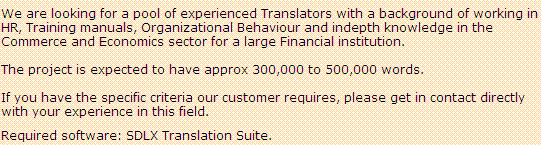
Here’s a breakdown of the project requirements:
- Specialized knowledge required: 5-6 areas of expertise
- Specialized skill required: SDLX Translation Suite
- Number of Japanese translators required: 67-111
- Number of proof-checkers required: 17-28
- Project setup time required: 3 days
As you can see, this project clearly cannot meet the three-day deadline while maintaining quality standards. So, what could possibly go wrong if the deadline is pushed?
What Happens When There’s No Translation Strategy?
When a strategy is missing, translation companies often resort to shortcuts to meet impossible deadlines. Here are a few common practices that compromise quality:
- Hiring unqualified translators – This could lead to errors, inconsistencies, and poor-quality translations.
- Using non-native translators – Non-native speakers may struggle with context, tone, and nuances, resulting in awkward or stilted translations.
- Increasing daily capacity – Pressure to speed up translations often results in mistakes and rushed work.
- Relying on machine translation – Machine-generated translations often produce nonsensical or awkward text.
- Skipping the proof-checking process – Without proper review, errors can slip through and end up in final materials.
In a competitive marketplace, launching a product under these conditions could severely damage your brand’s reputation.
How to Prevent Translation Errors and Save Money
To avoid costly errors, you need a translation strategy that focuses on quality and efficiency. Here’s a plan that can help your company stay on track:
- Set clear quality standards for every translation project to ensure consistency.
- Implement a project management system that effectively handles deadlines, resources, and communication.
- Hire a professional project manager to oversee translation projects from start to finish.
- Establish a single point of contact—usually the project manager—who can coordinate with all stakeholders.
- Develop guidelines for selecting the right external service providers based on project needs.
By implementing this strategy, your company can reduce translation errors, meet deadlines, and avoid unnecessary costs.
In the next part of this series, we’ll dive deeper into how you can further optimize your translation processes to protect your bottom line. Stay tuned!
About the Author
Ivan Vandermerwe is the CEO of SAECULII YK, the owner of Japan based Translation Company Tokyo Visit SAECULII for the latest professional articles and news on Japanese Translation Service
Copyright (C) SAECULII YK. All rights reserved. Reproduction of this article is permitted with inclusion of the “About the Author” reference as is (including text links, japan-translators.saeculii.com/), and this copyright information. Articles may not be altered without written permission from SAECULII YK.
 INTEGRATED LINGUISTIC SOLUTIONS &DISCUSS