
When it comes to using official documents abroad, accuracy and legal authentication are essential.
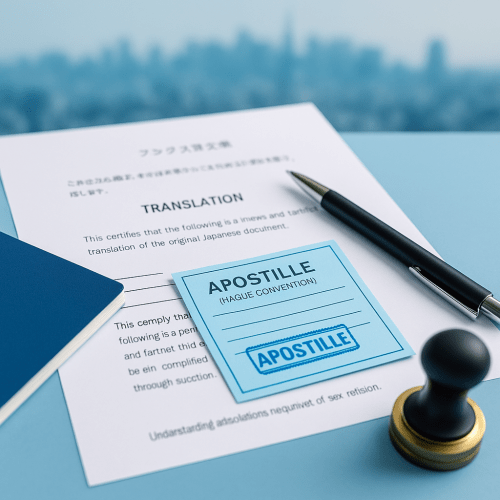
Many people, though, remain uncertain about what an apostilled translation actually is and why it is required. This confusion often leads to unnecessary delays, rejections, or legal setbacks.
In this post, we’ll explain what apostilled translation means, why it is an essential step for international recognition, and how professional translation services in Tokyo, Japan ensure your documents are fully compliant under the Hague Apostille Convention.
What Is an Apostilled Translation?
Official translation is an umbrella term that includes certified translation, sworn translation, notarized translation, and apostilled translation. Each type serves a different legal or administrative purpose depending on the destination country and the nature of the document.
An apostilled translation is a translation that has been authenticated with an apostille certificate, a special form of validation recognized under the Hague Apostille Convention of 1961. The apostille confirms that the document is legitimate and will be accepted by all member countries of the convention.
Only public documents can receive an apostille. If your document is private, such as a company record or academic transcript, it must first be notarized to become a public document. Once notarized, the government authority responsible for foreign affairs issues the apostille certificate.
In most countries, this authority is an external affairs or foreign office department. In Japan, the apostille is issued by the Ministry of Foreign Affairs (MOFA). The process adds an international layer of authentication, allowing your documents to be recognized abroad without requiring further legalization through embassies or consulates.
For a complete step-by-step guide, see What is Apostilled Translation – The Complete Guide
Why Self-Translation Will Be Rejected
Online discussions often promote the idea that individuals can translate and certify their own documents for official purposes. In one popular thread, a user claimed to have self-translated documents for years “without issue.” While this might sound like practical advice, it is fundamentally flawed and misleading.
An apostilled translation is part of an official, government-regulated process. It involves notarization by a notary public and subsequent authentication by the appropriate foreign affairs office. Suggesting that you can self-translate and have that translation apostilled ignores the strict legal framework that governs the process.
In short, apostilled translation sits at the intersection of language and law. It requires professional translators familiar with both, as well as coordination with notaries and government agencies. Attempting to bypass this process is not only impractical but ensures rejection.
Professional Translation Services in Japan
If you’re unsure whether your documents require an apostilled translation or another form of official translation, the best approach is to confirm directly with the organization or government office that will review them.
Working with professional translation services in Tokyo, Japan ensures that every stage—from translation to notarization to apostille—is handled correctly. Certified translators understand both the linguistic precision and the legal procedures required for international acceptance.
By partnering with qualified professionals, you eliminate uncertainty and ensure your documents meet the highest global standards of compliance and authenticity.
Go Global the Right Way – Get Apostilled Translations
Ensure your documents are accepted worldwide with confidence. Work with experienced professional translators who understand both the language and legal systems behind every translation.
 INTEGRATED LINGUISTIC SOLUTIONS &DISCUSS