
For expats living in Japan, navigating administrative hurdles is a rite of passage.
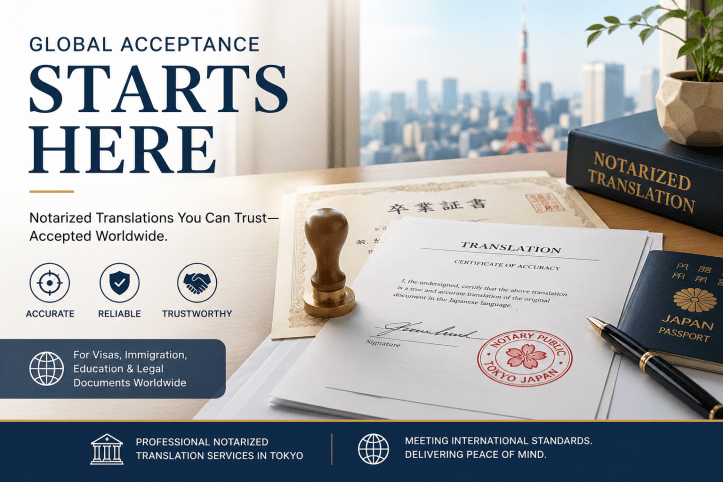
However, when it comes to official paperwork—visas, immigration, university applications, or legal filings—the stakes are higher. To ensure your documents are accepted by overseas authorities, you need accurate, reliable, and trustworthy information.
Understanding the nuances of notarization is the key to avoiding rejected applications and costly delays.
What is Notarized Translation?
A notarized translation adds a vital layer of legal credibility to your documents. In Japan, this process involves a licensed notary public verifying either the authenticity of your original document or the legitimacy of the translation itself.
This step is often required when submitting Japanese documents to foreign embassies or international institutions that demand a higher level of verification than a standard certified translation.
Take a deep dive with these Notarized Translation Resources »
Two Essential Types of Notarization
When seeking notarized translation services, it is vital to identify which type of authentication your receiving authority requires:
- Notarization of Original Documents: The notary confirms that your original document—such as a birth certificate or diploma—is a genuine “true copy.”
- Notarization of the Translation: The translator signs a Statement of Certification (Certificate of Accuracy) in the presence of a notary. The notary then verifies the identity of the translator and the legitimacy of their signature.
In some complex cases, you may even require both, followed by an Apostille or consular legalization.
Read How Much Authentication Do You Need? A Guide for Expats »
Why Verification of Requirements is Critical
The most common pitfall for expats is proceeding without specific instructions. Every country and institution has unique standards. Some may accept a translation certified by a professional agency, while others strictly require the seal of a Japanese Notary Public.
Before you commit to a service, always verify the exact requirements with the receiving institution. This proactive step ensures your certified translation is valid the moment it hits the reviewer’s desk.
Secure Your Notarized Translation Today
Ensure your documents meet the highest legal standards with our expert support.
Contact SAECULII for a Notarized Translation Services Tokyo Japan »
 INTEGRATED LINGUISTIC SOLUTIONS &DISCUSS